What Your Face Looks, There is a moment, usually caught in a photograph or a passing reflection, when something looks different. Not dramatic. Not altered beyond recognition. Just quieter. The tension that has lived in your forehead for years, the small furrow between your brows that deepens every time you concentrate on a screen, the subtle tightening around your eyes that follows a long week. All of it looks a little less loud. That is what a rested face looks like, and more people are beginning to understand how to get there.
The Hidden Cost of Constant Expression
The lines that form are not flaws. They are evidence of a life fully lived. But for many people, those lines begin to tell a story that does not feel accurate. The permanent frown that appears even when you are perfectly happy. The furrowed brow that stays long after the worry has passed. These are the expressions of a face that has never fully been allowed to let go, and for a growing number of people, that is a problem worth addressing.
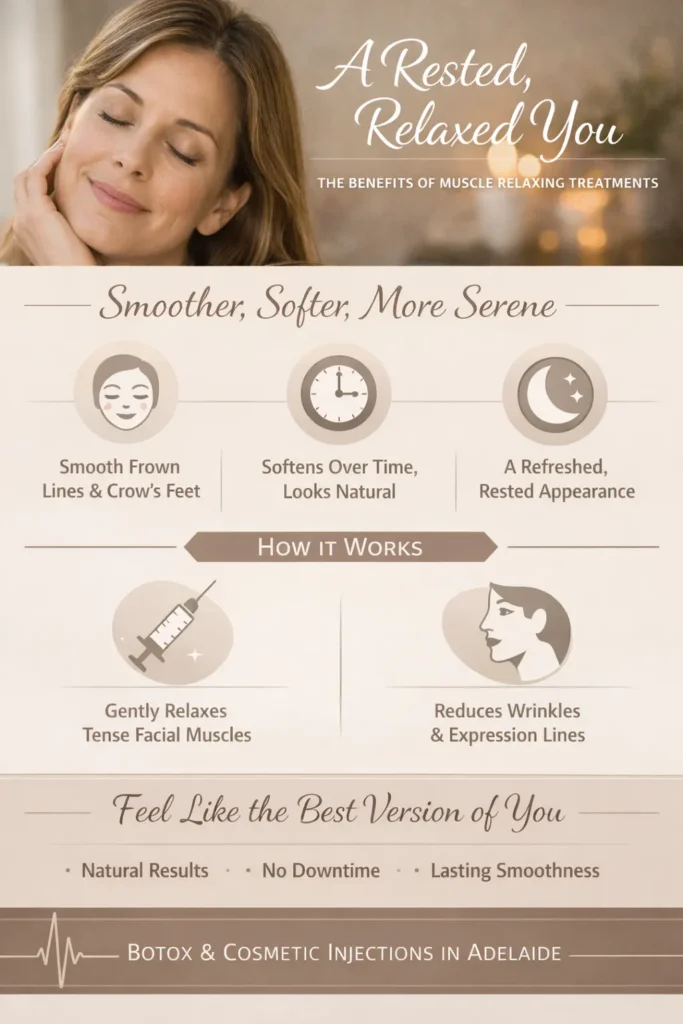
Understanding this shift is the first step toward understanding why so many people are turning to muscle-relaxing cosmetic treatments. The goal is not to erase personality or freeze emotion. It is to give overworked facial muscles a genuine chance to recover.
What Actually Happens Beneath the Surface Face Looks
When certain facial muscles are given the opportunity to relax through a targeted injectable treatment, the skin above them gradually softens. Lines carved by repeated movement begin to smooth, not because the skin itself has fundamentally changed, but because the constant pulling beneath it has paused.
This process is subtle and cumulative. In the days immediately following treatment, you may notice very little. By the second week, the difference becomes clearer. The face does not look frozen or strange. It looks like a version of itself that has had a very good night’s sleep, sustained across several months.
For people exploring Botox in Adelaide, practitioners often note that first-time clients are genuinely surprised by how natural the results appear. The expectation, shaped largely by outdated images from the early days of cosmetic treatments, is one of over-correction. The reality of modern, carefully administered treatment is far more refined and nuanced.
A Different Way of Thinking About Your Face
The broader cultural conversation around cosmetic treatments is shifting. Where earlier generations may have viewed these treatments with suspicion or associated them with insecurity, a growing number of people now see them as simply another considered dimension of personal care. Not fundamentally different in principle from physiotherapy for a chronically tight back or regular massage for persistently tense shoulders.
Your face works hard. Giving it a genuine opportunity to rest is not a concession to vanity. It is an intentional act of care directed toward one of the most expressive and visible parts of who you are. When you look in the mirror and see something quieter looking back, something softer without being diminished, that is not a loss of yourself. That is what your face looks like when it finally gets to rest.
Face Looks Face Looks